
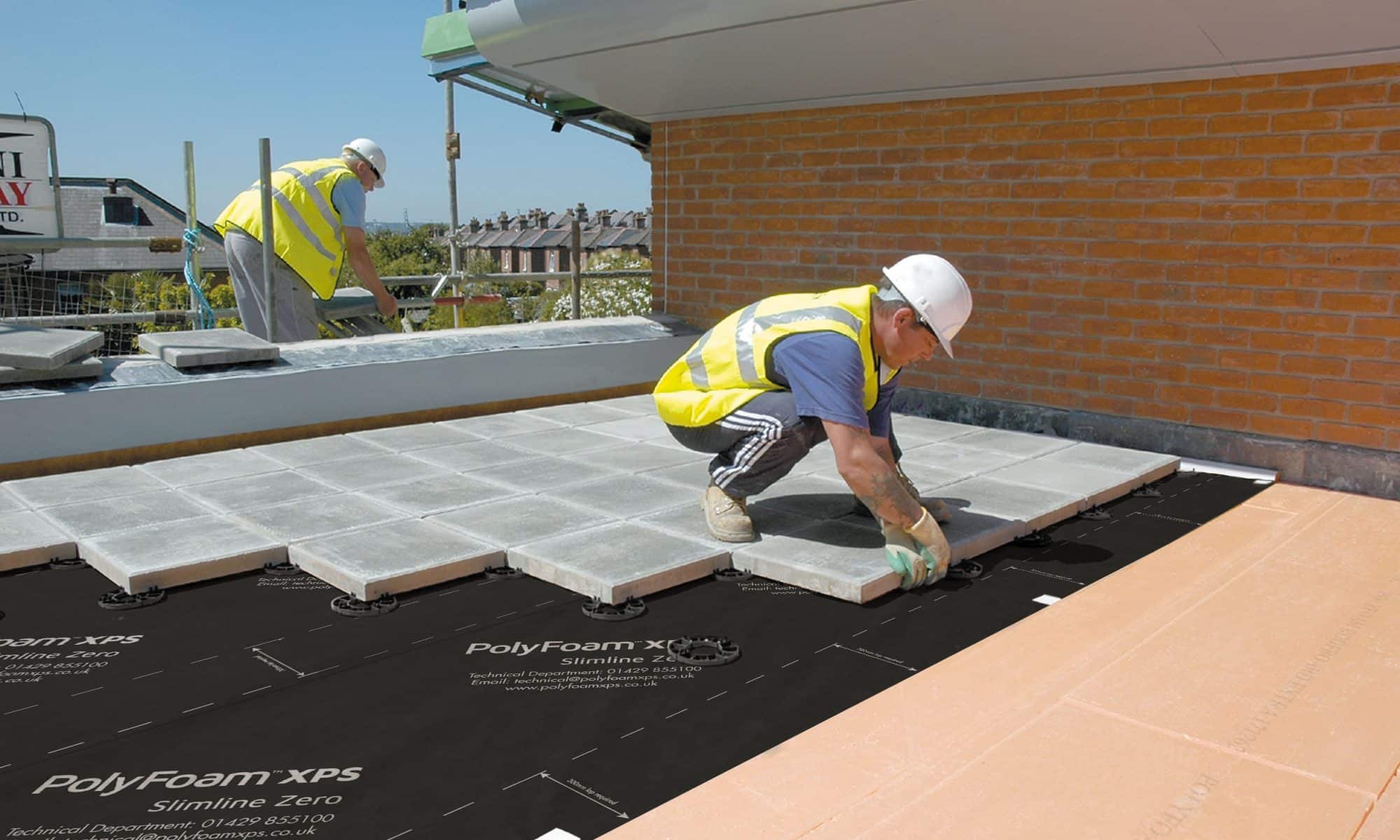
What are the qualities to look for in a water flow reducing layer (WFRL)?
In any good double act, success depends on the interaction between both partners. Even when one plays more of a leading role, it doesn’t mean they could be successful by themselves. The less-heralded of the two is still making an essential contribution, and the quality of the overall performance relies on how they play off one another.
What does any of this have to do with specifying and installing a flat roof, we hear you ask. When it comes to inverted roofs, there’s a reason the technical guidance document ETAG 031 refers to thermal insulation and a water flow reducing layer (WFRL) as a ‘kit’ – the two components are an indispensable double act.
A roof system greater than the sum of its parts
Whether you think our analogy is clever or laboured, it has one particular flaw. The double act is a longstanding tradition in comedy, whereas getting flat roof design and construction right isn’t about entertainment. The combination of insulation and WFRL is critical to inverted roof performance.
Thermal insulation tends to take the limelight in building fabric specification, simply because U-value targets are something of a be all and end all.
“A suitable insulation, like extruded polystyrene, can function by itself in the demanding environment of an inverted roof,” says Rob Firman, Technical and Specification Manager at Polyfoam XPS. “But when that insulation is coupled with a WFRL, the inverted roof kit delivers something greater than the sum of its parts. The membrane layer takes something of a back seat – it plays ‘the straight man’, as it were – yet gives the insulation the chance to perform at its best.”
In a post about the importance of WFRLs, we explained how they benefit the roof performance and we talked about them becoming a required, rather than optional, element of inverted roof build-ups. They are effectively used as standard anyway, so it would make sense to see that codified in roofing codes of practice.
There is a difference, however, between a specifier selecting a WFRL in the roof specification, and how a contractor views the product when they are handling it on site.
Not all WFRLs are the same
The fundamental performance requirements for a WFRL are relatively straightforward: ETAG 031 says it should be It should be a synthetic non-woven membrane that is water resistant, diffusion open, UV stable and rot resistant.
Comparing membranes on paper and assessing these core qualities can make one WFRL seem very much like another. However, this apparent similarity does not translate to site, where contractors can find themselves handling products that feel very different from one another.
“Some membranes offered as WFRLs are so thin they feel almost like paper,” Rob Firman explains. “Combine that with the loose laid installation of the WFRL and its little wonder that a contractor might – as has been our experience – question what they are installing or how effective it can be.”
Just like the insulation products they’re used with are manufactured to a harmonised standard (BS EN 13164 in the case of XPS), a WFRL membrane has its own harmonised standard. BS EN 13859 Flexible sheets for waterproofing. Definitions and characteristics of underlays has two parts. The first covers underlays for roofs, the second underlays for walls; a membrane may be tested to just part 1, or both parts.
Start to dig deeper into the testing and performance declarations covered by BS EN 13859 and you begin to uncover a host of qualities that could make a crucial difference to how a contractor perceives a product and what quality of installation is ultimately achieved in the finished roof.
Tensile force, elongation, resistance to tearing, and flexibility at low temperatures are all tested and measured characteristics of membranes offered as WFRLs. All except flexibility are measured in both the machine direction and the cross-machine direction, adding an extra layer of comparison to declarations for different products.
Expecting specifiers and installers to examine Declarations of Performance (DoPs) for different WFRLs and understand every slight difference between them is unrealistic. But what we have hopefully highlighted is the potential scope for difference between similar-seeming products.
These ‘hidden’ qualities have a say in how the WFRL plays its role in the inverted roof kit double act. They can affect how a roof finish is installed, and the long-term performance of the roof in service.
What to do next
WFRLs are part of inverted roof testing, which helps to establish that the membrane meets basic performance criteria. Specifiers can take roof designs a step further by engaging with manufacturers to better understand the WFRL product on offer. That engagement, coupled with relevant technical information like DoPs, can help to make more informed decisions for the long-term benefit of the roof.
Specifiers and contractors can also engage in dialogue to determine what qualities are important to the installer of the insulation and WFRL. Not every project will offer an opportunity for such collaboration. Where it is possible, two-way feedback could result in (a) contractors working with a product they feel more comfortable with, and (b) give specifiers more confidence that their roof specifications on paper can be delivered on site.
Polyfoam XPS welcomes any opportunity to engage proactively with both specifiers and contractors. Find out more about our inverted roof kit offering generally, and our Polyfoam Slimline Zero membrane specifically. Contact us with any queries about inverted roofs and inverted roof kits.