
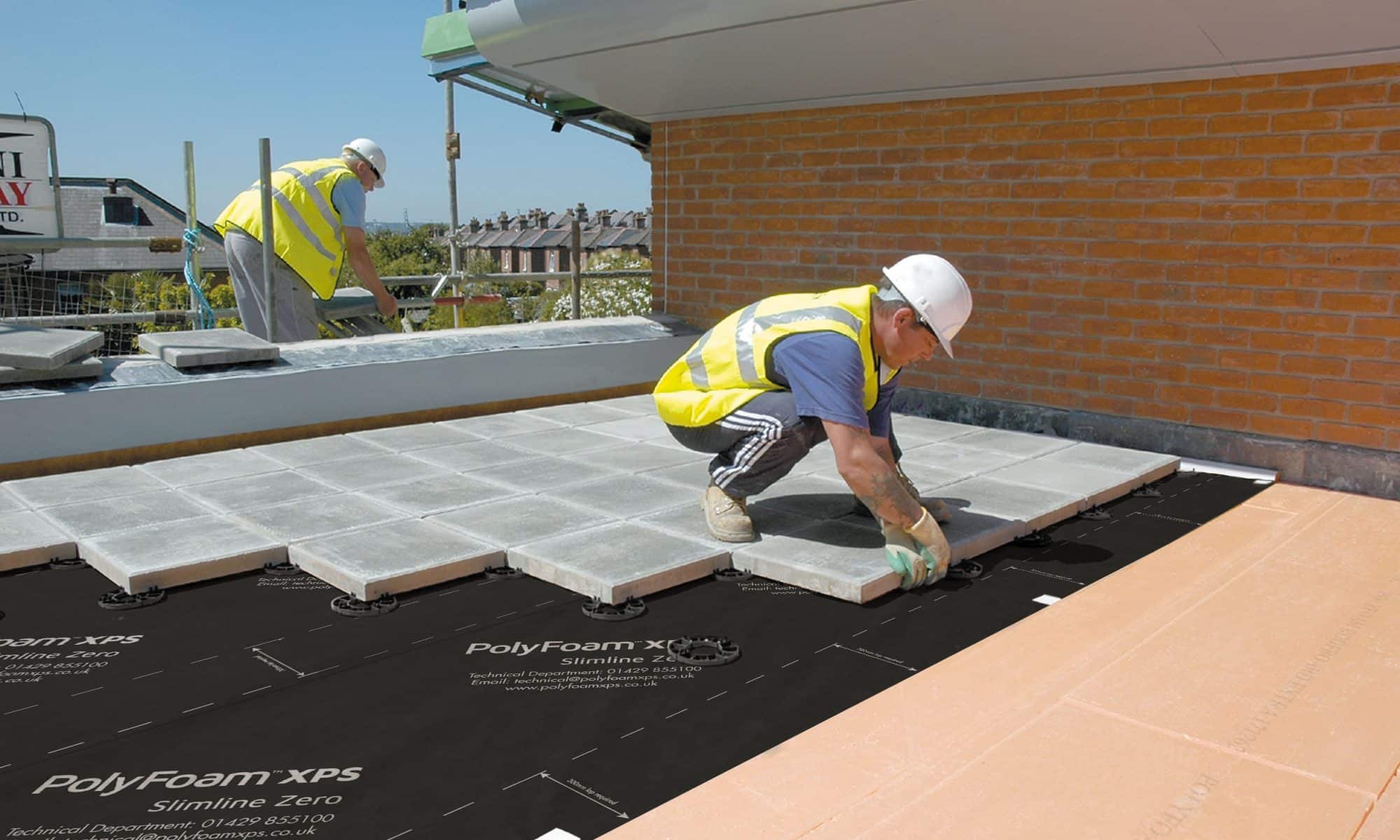
THE IMPORTANCE OF A WATER FLOW REDUCING LAYER (WFRL) IN INVERTED ROOFS
The inclusion of water flow reducing layers (WFRLs) in inverted flat roof build-ups is so widely accepted that it might surprise people to realise they are, in fact, an optional component of the roof system. However, such is the effectiveness of a WFRL in that system that the membrane’s removal from a specification would significantly penalise the long-term performance of the roof.
At the time of writing in early 2024, the flat roofing standard BS 6229:2018 Flat roofs with continuously supported flexible waterproof coverings. Code of practice is due for review. Since the last major revision in 2018, the inverted roof sector has put a lot of time and effort into better understanding WFRLs and their contribution to roof system performance. Perhaps, then, it is time to consider amending industry guidance to reflect the use of WFRLs as standard?
What are the two main functions of a water flow reducing layer (WFRL)?
An inverted roof construction features waterproofing applied to the structural roof deck. The insulation layer is then installed over the waterproofing, followed by a roof covering (usually gravel or paving slabs) that also serves as ballast for the insulation.
The WFRL is a membrane layer, loose laid over the thermal insulation before the roof covering is installed. Installed in this position, it serves two principal functions.
One is to prevent dirt and grit (‘fines’) being washed into the joints between insulation boards, which could potentially act as a thermal bridge over time and hinder the movement of rainwater through the system.
To that end, the WFRL’s other main function is to act as a barrier to rainwater entering the inverted roof system in the first place. The volume of water that can reach the waterproofing layer is therefore reduced.
What does BS 6229:2018 say about WFRLs?
Clause 4.2.2 of BS 6229:2018 illustrates a typical inverted roof build-up. As part of that, Figure 2 includes a WFRL, with no mention of the layer being optional.
However, note 2 to the clause says: “To regulate the movement of water … a water flow reducing layer (WFRL) may be placed on the insulation layer.” The bold is our own emphasis for the purposes of this blog post.
Recent industry conversations have highlighted how it is standard practice within the inverted roof sector to include a WFRL as part of inverted roof systems. Among a host of roofing system manufacturers and suppliers, Polyfoam XPS included, nobody was aware of inverted roofs being installed without a WFRL.
There is no inherent harm in the layer being identified as optional. Nevertheless, we feel it would be better for the industry’s code of practice to reflect the standard approach and substantial benefits of all inverted roofs being constructed with a WFRL in place.
How does a water flow reducing layer (WFRL) improve inverted roof performance?
The positive impact of a WFRL on roof system performance derives from its effectiveness in stopping rainwater from entering the insulation layer – though it is important to be clear that a WFRL is not a waterproof layer.
Even with a WFRL, the idea behind an inverted roof is that rainwater can reach the waterproofed deck (as described in BBA Information No. 4). It should never be assumed that no rainwater will enter the system, and design (rather than declared) lambda values should be used for the insulation layer.
Despite this, WFRLs do typically perform well in independent testing. As a result, it is common for a minimum fraction (known as the f value) of 0.025 to be used as part of the rainwater cooling correction in U-value calculations, to represent 2.5% of the rainwater reaching the waterproofing layer.
Without the WFRL, more water reaches the waterproofing layer. The effect of rainwater cooling on the roof U-value calculation therefore increases. This leads to a significantly thicker layer of insulation, which increases the depth of the roof build-up, adds to the material cost of the inverted roof system, and potentially requires more time and labour to install.
Consider also that, without a WFRL, there would be nothing to stop fines from entering the roof system. Over the course of a building’s useful life, the impact of fines building up within the insulation layer could lead to worse-than-expected thermal efficiency, increased maintenance, and maybe even a shortening of the roof system’s service life.
At a time when we need to minimise the whole life carbon emissions associated with buildings, and rely on them delivering their designed performance reliably and consistently over 50 or 60 years (or longer), WFRLs like Polyfoam Slimline Zero membrane have a significant role to play. Industry codes of practice should fully reflect that role.
For accurate inverted roof U-value calculations based on up-to-date guidance, including using design lambdas and appropriate correction factors, contact Polyfoam XPS for technical support.
April 2026 note: this blog post is about, or contains reference to, the 2018 edition of BS 6229. The post’s contents were accurate at the time of publication. Since December 2025, an updated version of the flat roofing code of practice has been in effect and we have written a post outlining the main changes in BS 6229:2025.
We have retained historic references to BS 6229, such as in this blog post, as a record of the 2018 standard for projects that followed its recommendations. Some recommendations may have carried across to the 2025 version. In addition, general content in this post that is not specific to BS 6229 may also still be current.