

There is no reason that extruded polystyrene (XPS) insulation cannot play a role in the construction industry’s transition from the linear economy to the circular economy. XPS’s combination of performance characteristics – including its robustness, compressive strength, moisture resistance, and long-term thermal performance – mean it has the potential to be retained or reused across multiple building life cycles.
Whether XPS does contribute to the adoption of circular economic principles depends on how an individual project is designed, and what sustainability goals are adopted for the project from the outset. That was the subject of our Part 1 blog post, which looked at how sustainability is defined in the construction industry. As more projects show how the circular economy can be embraced, the practice should become more widespread.
What is the circular economy?
The UK Green Building Council (UKGBC) describes the circular economy as follows: “At its simplest, the circular economy prioritises the reuse of materials, preventing the over-extraction of natural resources and the number of usable materials that end up in landfill.”
In the linear economy, a product is used once and then disposed of, requiring new resources to be extracted and new products to be manufactured. As the global population grows and the demand for raw materials and construction products continues to increase, maintaining the linear economy approach will only put further pressure on already-limited resources.
As we said in our first blog post on this subject: “Designing buildings with a 60-to-100-year lifespan, demolishing them and creating waste, then building again from scratch is the linear economy in action. The linear economy is incompatible with a sustainable, net zero future that prioritises efficient use of the limited resources available to us and minimises negative biodiversity impacts.”
What is the waste hierarchy?
The waste hierarchy outlines methods of dealing with waste in order of desirability. While the circular economy is preferred to the linear economy, it is not actually the most desirable option in the waste hierarchy.
A briefing paper by the Construction Products Association (CPA), titled, ‘What is the waste hierarchy?’ shows that the preferred option is to prevent waste altogether.
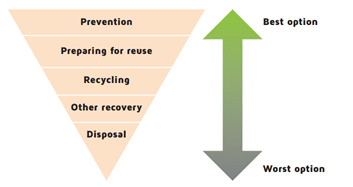
“It is often said the most sustainable building is the one that doesn’t need to be built,” explained Rob Firman, Technical and Specification Manager at Polyfoam XPS. “That is based on the idea of prevention, and making use of assets that already exist.”
The worst option according to the hierarchy is to dispose of waste, and there are other methods in between.
What are the five circular economy principles for construction?
To support greater adoption of the circular economy, the UKGBC provides guidance on five circular economy principles for construction, in order of priority.
- Maximise reuse
The highest priority is to maximise reuse. In the first instance, this means reusing buildings themselves. Second, it means recovering materials from a site to be used on the same site or a different site.
Specifying XPS can support both of these aims, assuming projects are designed with such outcomes in mind.
“At the level of whole building reuse, a traditional concrete slab ground floor might still be specified, but featuring XPS insulation instead of an alternative rigid foam board,” said Rob Firman. “With its higher compressive strength, XPS would be capable of bearing potentially increased loads from an unknown future use.”
Leaving the entire ground floor build-up in place during future conversion/adaptation works would leave the insulation undisturbed, ensuring it continues to deliver its performance.
For the recovery of materials from an existing building, there are ways in which XPS is installed that could support the future removal and reuse of insulation boards.
An inverted roof build-up is loose laid, meaning the insulation is neither mechanically fixed nor adhered. Should a building with an inverted roof be disassembled in future, the roof finish and ballast layers could be taken up, followed by the XPS insulation layer. Assuming good installation at the outset, the insulation boards should be in virtually the same condition as when first used.
- Design for optimisation
The UKGBC’s guidance lists the following four aspects to designing for optimisation.
- Longevity.
- Flexibility.
- Adaptability.
- Assembly, disassembly and recoverability.
XPS’s proven durability can contribute to the longevity of building design lives. We have already covered the ways in which it might support adaptability and assembly/disassembly/recoverability.
The example of an inverted roof also plays in to designing with flexibility in mind. A roof constructed today to achieve a certain level of thermal performance might require an increase in insulation thickness at a later date. The loose laid nature of an inverted roof could play into this, allowing the roof finish and ballast layers to be lifted temporarily and an extra insulation layer added, prior to reinstating the layers above. Issues like thresholds and their heights would need to be considered during the initial design. Overall, however, such flexibility is a realistic possibility.
- Use standardisation
This refers to the use of standardised, modular elements in a construction project. As a manufacturer of insulation boards, there is no direct way we can influence the adoption of standardised elements on any given project. However, our products could be used by a modular or offsite manufacturer.
- Products as a service
At the time of publishing, this is not something that Polyfoam XPS has explored.
- Minimise impact and waste
Three of the four aspects named by the UKGBC in this area are: use low impact new materials; use recycled content; and reduce construction impacts.
As a plastic-based material, it is hard to argue that XPS is a genuinely low impact material. Given the importance of thermal insulation in buildings generally, plus XPS’s combination of characteristics, and the potential for adaptability/flexibility/reuse discussed above, there are justifiable trade-offs against that unavoidable impact.
It is incumbent upon product manufacturers to be open and transparent about their processes, and the way they are striving to improve them.
To that end, we have written extensively about the continuous improvements we have implemented at our factory, especially in terms of waste management and diverting waste from landfill. In the same post, we also discuss the use of recycled content in our products. This is explored further in our blog post about manufacturing XPS insulation.
Another way that product manufacturers can demonstrate a responsible attitude to the impact of their activities is by making improvements to the sourcing of materials. The BES 6001 responsible sourcing standard is a form of third-party certification for construction products, and is another topic we have written about in detail.
Removing barriers to reuse and recycling in construction
This blog post is centred on the circular economy and reuse. For more information about recycling XPS to avoid sending material to landfill, you can read our in-depth post about whether XPS insulation can be recycled, and our story about how we supported the recovery and recycling of insulation boards from two existing roofs.
A significant barrier to reuse, and even to recycling, is that design and installation rarely takes into account the end of a building’s life. As buildings can stand for 50, 60 or 100 years, or more, this is hardly surprising. How can you ensure that someone follows through on intent so many years later?
That is where we come back to agreeing sustainability goals at the very beginning of a project, and ensuring design and specification decisions align with those goals. Contractual performance for contractors and installers should prioritise the goals being met, and measured accordingly.
A golden thread of information can also record such decisions being made, and help carry that information through the life of the building so it is available to whoever makes end-of-life stage decisions in the future.
As part of our commitment to supporting the use of XPS through all stages of construction projects, you can contact us to discuss the subjects raised in this post and specifying/installing XPS in response to them.
To make sure you stay up to date with our latest blog posts, subscribe to our monthly email newsletter, The Build-Up, or follow the Polyfoam XPS LinkedIn page. Finally, if you found this blog post useful, please consider emailing it to a colleague or sharing it so that others might benefit from it.
April 2026 note: this blog post is based on content written for the first edition of The Polyfoam Orange Book of XPS Insulation, our comprehensive guide to extruded polystyrene (XPS) published in March 2026. Written for designers, specifiers and contractors, you can learn more about the book, including how to request a copy, here.